
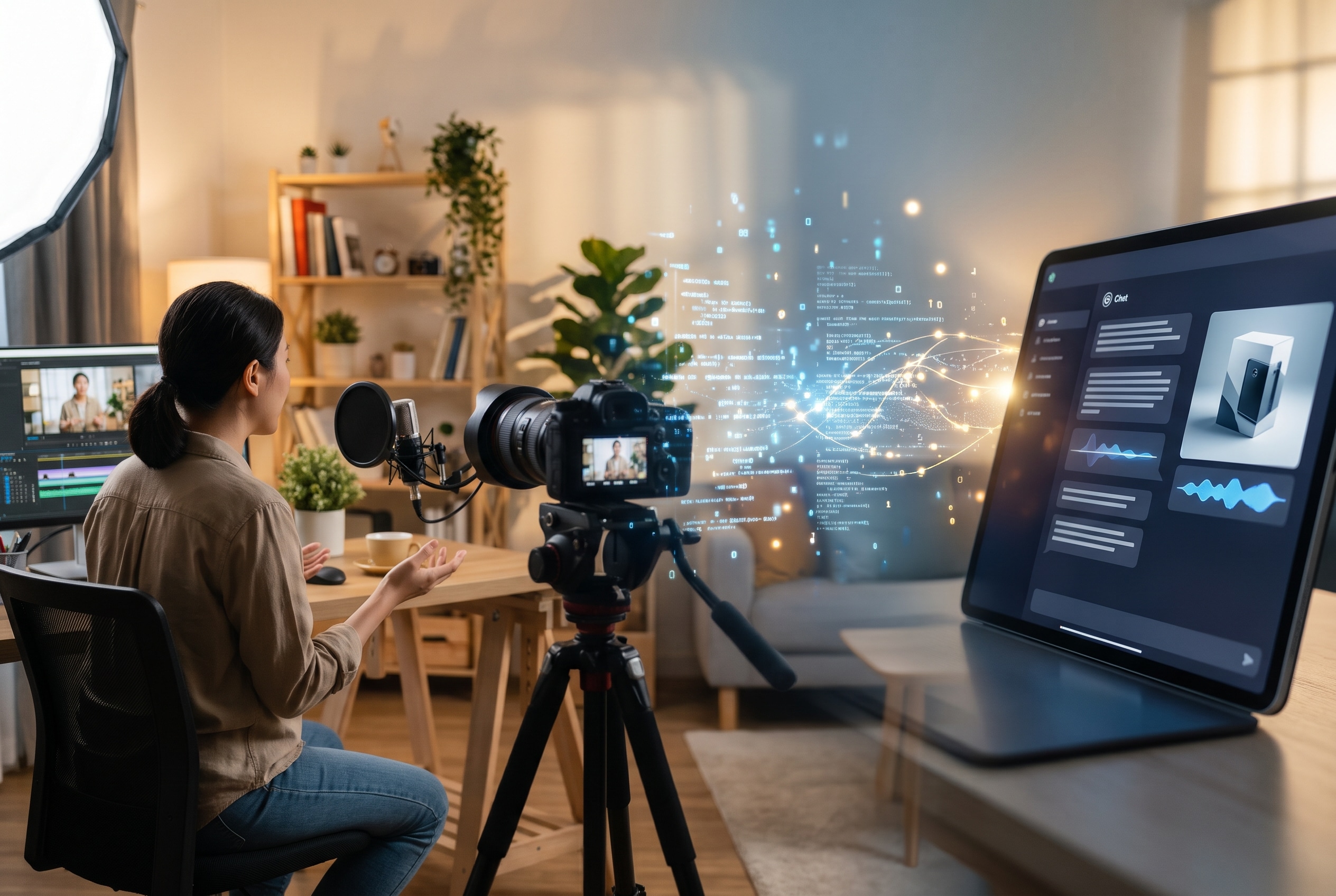
When your customers ask ChatGPT, Perplexity, or Gemini to recommend “the best skincare routine for sensitive skin” or “the ideal laptop for video editing,” where does the answer come from? Contrary to what one might assume, artificial intelligence does not rely solely on e-commerce websites or tech media reviews: it draws recommendations extensively from creator videos.
A recent study by analytics firm Sundogs highlights a historic shift in search and influencer marketing. While traditional search engines prioritized keywords and backlinks, large language models (LLMs) deeply index and analyze what creators actually say. The issue? Most brands still approach creator partnerships using yesterday’s playbook, completely missing out on this emerging acquisition channel.
New AI Criteria: The End of “Vanity Metrics”
To understand how to surface in AI-generated answers, you first have to unlearn the rules of TikTok, Instagram, or traditional SEO algorithms. LLMs do not prioritize virality or vanity metrics.
- View count is no longer a filter: The study reveals that a video with barely 800 views has just as much—if not more—chance of being cited by an AI as one with 2 million views, provided it accurately addresses the specific use case.
- A premium on long-form content: Videos lasting 8 minutes or longer account for virtually all sources leveraged by AI models. Short-form video (Shorts, Reels, TikTok), being too superficial, is overwhelmingly bypassed by AI recommendation summaries.
- Longevity over recency: AI engines consistently cite videos published one or two years ago as long as the information remains relevant. Video content becomes a durable, compounding asset.
- Rejection of purely promotional scripts: Only 10% of videos recommended by AIs originate from strictly brand-controlled partnerships. LLMs favor authenticity and perceived neutrality.
4 Strategic Takeaways for Brands
This transition toward GEO (Generative Engine Optimization) applied to influencer marketing requires updating your briefs, targeting criteria, and collaboration models with talent.
1. Incorporate long-form, explanatory formats into your media mix
Short-form content remains king for rapid brand awareness and algorithmic discoverability on social feeds, but it fails to feed LLMs. Brands should systematically allocate part of their budget to in-depth analytical formats on YouTube or video podcasts: thorough stress tests, practical tutorials, and technical comparisons. It is within this dense content that models extract purchasing rationale.
2. Loosen brief constraints: embrace nuance and comparison
A brand’s default instinct is often to demand a tightly controlled script with zero mentions of competitors and repeated superlatives. This is precisely what disqualifies content in the eyes of an AI. For a video to serve as an authoritative reference for an LLM, the creator must be able to benchmark the product against alternatives, highlight its strengths, and candidly address its limitations. Editorial honesty has become an algorithmic indexing signal.
3. Reassess the value of niche and subject-matter experts
Micro- and nano-influencers take on an entirely new value proposition. A creator dedicated to mechanical engineering, B2B SaaS, or clean cosmetics may not generate millions of views, but their specialized vocabulary, technical rigor, and granular assessments build strong semantic authority for language models. Partnering with these profiles for their domain expertise directly drives visibility across high-intent search queries.
4. Optimize spoken scripts for conversational user queries
AI systems transcribe and vectorize the audio tracks of video content. For your product to surface when a consumer asks a complex question (e.g., “What product should I use to eliminate irritation after daily shaving?”), the creator needs to explicitly vocalize that exact problem and provide a clear solution. The more an audio script addresses specific, real-world use cases, the easier it is for a language model to extract and recommend your brand.
Influencer Marketing Enters the Era of Semantic Recommendation
Influencer marketing is no longer just about capturing fleeting attention in a social feed; it now feeds the knowledge base of artificial intelligence systems guiding everyday purchasing decisions. Brands willing to relinquish rigid editorial control in favor of thorough, authentic creator partnerships will secure prime positioning at the exact moment consumers consult their AI assistants.
